Showing posts with label vancouver island. Show all posts

Monday, September 05, 2011

Five hundred words

Because this picture only tells half the story.

This is an adult female osprey.

She carries a perch in one talon.

She has two nearly grown nestlings.

She was in the middle of feeding one of her nestlings when a male osprey (not her mate) flew near her nest.

In this shot, she's in the process of chasing that male away while hanging on to the fish.


Seriously. Why do I love these birds?

Saturday, July 16, 2011

Welcome to Camas Country

This photo is from earlier in the spring.


Found a great story about the importance of this plant — Camas quamash — to this region on the Beacon Hill Park history website. And I'm sharing because I seem to be lacking time to write.

Wednesday, July 06, 2011

Launched at last

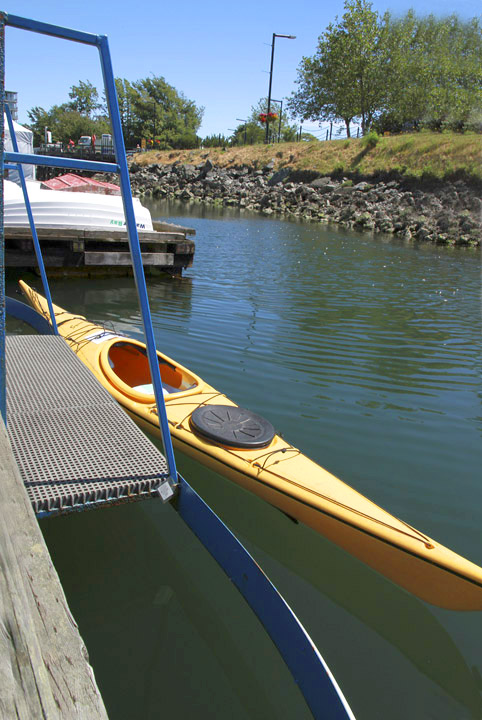
I brought my kayak down to Victoria from Sproat Lake in January and only just got it in the water on the Canada Day long weekend.


I hate to admit it, and maybe it's a good thing, but I've become a lot more cautious.

My kayak lives at Fisherman's Wharf in Victoria's busy harbour. As soon as I poke my nose out, I'm in the traffic. I need to be mindful of float planes, whale watching boats and big ferries like the Coho lest I make the kind of navigational error that make real mariners cringe.

Even worse than that, I don't want to be the unprepared novice in need of rescue who makes the six o'clock news. I do not experience the same hesitation about my terrestrial adventures, but perhaps I should.

I recognized myself in the movie 127 Hours as the solo hiker who doesn't use a check in person (I know  it's wrong Susie, I know).

I guess I find it hard to define when a day hike becomes an activity that requires such precautions. I think we are made to be fearful of outings that are not high-risk. I'd like to think I know when to let someone know where I've gone and when I expect to return.

So I took it easy. I took it slow. Got comfortable with getting my vessel on and off the dock (thanks for the handy grid Victoria Harbour Authority!).

Next time I may venture beyond Laurel Point. When I really get comfortable I will paddle out of the harbour and to sea.

Saturday, June 18, 2011

Gowlland Tod Park (part I)

I visited this park many years ago, but rediscovered it this spring and it seemed larger and wilder than I remember.

I've now made a few trips in order to span the 13 km ridge-top trail above the Saanich Inlet.


My first discovery along the trail was this little orchid. The fairy slipper (Calypso bulbosa) grows in dense forests along the coast from Washington State up to Alaska.

All of the wildflowers seemed especially plentiful and brilliant, possibly due to the long, cool spring we've had.

I started from the north end at McKenzie Bight and hiked the Timberman Trail along the top of the mountains standing on the east side of Finalyson Arm, deep in the Saanich Inlet.


The rest of the suspects were usual. This grey squirrel rushed my lens during the time it spent investigating me. Seemed very tame even though we met nearly smack dab in the middle of the trail where the fewest hikers venture.

Like so many Vancouver Islanders I've looked over at these green hills while racing along the Malahat drive on the other side of the inlet and wondered at that great stretch of wilderness.

One minute you're in town, the next you are out there on a ridge top, looking above at a kettle of turkey vultures and below at a little sip of the Pacific coming in to meet the salmon rivers that pour off the land.


My preferred stop on this hike was the Malahat Lookout where the big raptors soared.


I can't help it. I like it when I'm above the eagles.

Sunday, June 12, 2011

Osprey on the island

It's been hard to know how many osprey are around the Victoria are because I have little time to watch them.

I saw this one at Patricia Bay on the Saanich Inlet in early May, handily scooping fish from the shallow waters.


This would be pre-nestlings, so the birds aren't yet rushing about. 

There's time for perching and eating without disturbance.  That will have all changed by now in nests that have successfully produced young. I know of two in the Victoria are that I'm concerned about.

One is in Esquimalt and the female on that nest died last summer after fledging two chicks. The wildlife rescue centre that received the dead bird reported that she was riddled with tumours but they did not manage to do a necropsy (long story).

The other is the nest of the campus sweethearts from last summer. They lived high above a soccer field at the University of Victoria. So far this year, I have only seen the female hanging around what remains of the nest, seemingly waiting for the arrival of her mate.

So there it is. There are plenty of osprey to chase, and not the time to do it in. I'm planning though, don't worry, I'm planning.


Sunday, June 05, 2011

Peregrinations

Caught this peregrine at Patricia Bay on the Saanich Inlet of southern Vancouver Island.

It sat in one of the Douglas fir trees lining the beach, inconspicuous among the bald eagles and osprey spectacularly soaring around.

I went round and round the tree trying to get a clear shot. When I moved, the falcon moved. Very common experience.

Finally a crow spotted the intruder and flew over to dive repeatedly at the peregrine. It grew tired of the attack (which went on behind a leafy branch) so I snapped it on the wing as it flew off (in disgust?).

You just can't get any peace at the beach anymore.


Saturday, May 21, 2011

Hornby Island

Each of the Gulf Islands that lie between Vancouver Island and B.C.'s coast has a different flavour. Hornby Island gets views of snow covered mountains in both directions with its own funky mix of artisans and people who've retired from the rest of the world.


On this trip my travelling companions were after pottery from one specific potter — Susan Crowe at Cannon Road Pottery.

I loved the outdoor gallery and the way her creative talents carry over to the way she displays her work.


In the laid back way of islanders, she feels no compulsion to operate a website. She can be reached the old-fashioned way for viewing (250.335.1629).


The requisite bald eagles perch by the seaside. Some have their own webcam broadcasting life in the nest around the clock. People from around the world watch eagle cams in British Columbia and the Hornby Island birds started it all.


I once met a woman from Japan who travelled across the Pacific to see the eagles in person after watching them on her computer for several years.


Finally, the views from Helliwell Provincial Park make it one of the best strolls anywhere on the islands.

One of the few marine protected areas, the waters around the park are closed to commercial fishing. While recreational fishing is allowed, islanders have instituted a voluntary closure allowing marine life a small haven.


Friday, April 15, 2011

The viaduct: one of Victoria's wetlands

As a transition zone between land and water, wetlands provide habitat for plants and animals that are terrestrial, aquatic and amphibious. The mix makes for high species diversity.

These productive ecosystems have been viewed largely as a nuisance to people wanting to develop land whether for agriculture or residential developments and roads.

Besides being prime wildlife habitat they filter water and break down detritus that flows in from the land around them.

In Canada many important wetlands have been filled in so we could build on top of them. Attempts to restore former wetlands have demonstrated that we can not recreate these complex landscapes, so our best bet is to conserve what's left.

Wetlands make a good bird outing at any time of year but they really bustle in the spring.

Mixed flocks of ducks paddle about seeking mates. Here's a female hooded merganser – or hoodie – hiding out behind some woody shrubs. Pretty dramatic look for a female.

She will find a tree cavity to nest in the year before she is actually ready to breed.

As a year round resident she can keep an eye on it and not have to race back from the south in the spring to claim it.


For food, hooded mergansers dive under the water and look for aquatic insects and crayfish. According to the Cornell Lab of Ornithology they can change the refractive properties of their eyes to see better in murky water.


Thursday, March 24, 2011

An oystercatcher by any other name

The black oystercatcher is not quite correctly named.

It could be called the black limpetcatcher, or the black musselcatcher to be more accurate in terms of what this shore bird eats.

Described as "just plain comical" by Nancy Baron and John Acorn in their Birds of Coastal British Columbia guide book, some researchers are taking this bird seriously.


The Pacific Wildlife Foundation and Parks Canada selected the bird as an indicator species of rocky intertidal community health.

To start that meant learning all about populations and movements to get a baseline measure. It is already known that the species is not threatened. The global population is around 10,000 individuals. Most live in British Columbia and Alaska.

They forage along rocky shores, often in urban settings, making it a good species for measuring the effects of human disturbance. 

This fellow at left was boldly stalking the shores of a beach in Sidney, just north of Victoria. About 100 pairs nest in the Strait of Georgia between Vancouver Island and the mainland.

To get the local population data, many birds were banded. Researchers hope people will report sightings here.

Haida Gwaii oystercatchers have orange or dark blue bands on their left leg.
Pacific Rim National Park birds have white bands with black letters on the right leg.
In the Gulf Islands they have orange bands with black letters.
BC mainland coast oystercatchers have yellow bands with black letters.

If you see a banded oystercatcher, note the band colour and numbers (if visible) and your location.

Tuesday, March 08, 2011

Have you seen this bird?

It's British Columbia's most widespread and abundant warbler.

A small number of these hearty songbirds overwinter on Vancouver Island. A pocket population socks in on Stubbs Island near Tofino, B.C. where a forest of California wax-myrtle provides them with food and shelter. It's the only place the plant grows on Vancouver Island.

The berries are purple, contain a single seed and have a white wax coating. They are unusual in that the fruit ripens late in the fall, providing a bounty of calories in the winter when other plants are dormant. If the bushes were removed, the birds could not stay.

Each time we cut a tree, hack a bush, pull up a plant the little community of organisms that depend on it have to find a new home or source of food. When we need we should harvest. When we don't, we should leave it for the other species that live on this planet.


Sunday, February 06, 2011

A question of culling

There's been talk lately of culling deer on southern Vancouver Island. In Garden City, it seems, folks are fed up with herds of herbivores chowing down on their pansies and petunias.

While some talk, others have been hunting in the suburbs with crossbows and leaving beheaded deer carcasses behind. 

Wolves and cougars keep populations in check in less urban areas on the Island but cities offer refuge for deer and the open habitat with a wide variety of foilage they prefer. Wolves and cougars that follow them into town get shot on sight.

Besides reducing annuals and perennials, large deer populations remove the shrubs and plants songbirds rely on — especially on islands.


The results of recent research done on the San Juan Islands (where this lovely creature was photographed) suggest that the larger the deer population, the fewer kinds, and numbers, of birds. 

A similar study done on Haida Gwaii in 2005 found songbird abundance 55 to 77 per cent lower on islands where deer lived for more than 50 years, compared to islands with no deer.

Similar problems exist in the Gulf Island archipelago to the east of Vancouver Island.

The researchers state that if deer are not actively managed, local extinctions of native plants and birds will accelerate in the decades to come.

I'm generally not for human interference with wildlife, but humans tend to be the cause of such problems. Animals are introduced to places they may not have colonized on their own because we want to eat them, or look at them.  

And songbirds already have enough to contend with as they are hunted by house cats, lose habitat to development and fly into windows. Migratory bird populations are in sharp decline across North America. Birds will be further threatened by the effects of climate change.

Or maybe we should leave well enough alone since our meddling usually creates more problems.


Thursday, August 19, 2010

Holding back

I'd like to tell you the whole story of the osprey, up above the shipyard. The female giving me glaring looks. But I have to withhold while I seek a market for the tale.

I can share some photos. I've had two sessions now and anticipate a third.


And I can tell you this. This osprey pair had three chicks in spring – small, medium and large. Fledging three chicks is rare in raptors. Siblicide is common and it seems quite likely that medium and large kicked their weaker nest mate out some time in July. At the very least their greater size allowed them to keep the fish away from small, so the bird may have simply faded away.


That's life. In this case it's a two-for-one deal. And before you cast human judgements at the adult birds who turn a beak to this. Reproductive investment for a bird that lives a long time and has few offspring comes close some years to costing them their lives. In terms of survival of the fittest and passing on their genes, their best bet is to back the winners.

Saturday, June 19, 2010

Campus sweethearts

To say I'm happy with my new camera outfit would be a bit of an understatement. I resisted as long as I could, in loyalty to my old 20D, but I have to admit that five years in digital technology time makes a noticeable difference.


Once my 70 to 200mm lens arrived I practically ran up to the University of Victoria to snap the pair I've been following up there.

These two have opted to nest on a light standard stuck between the soccer pitch and the track and field facility. That means it's a busy place, not only home to the uni athletes, but also the site of competitive sports between people much younger and older than that.

And the funny thing is that the osprey kind of squawk through the commotion. Like they didn't choose to nest in a busy urban environment, for at least the second year running.

The good thing about osprey is that they can fledge chicks just as well from a nest in a grocery parking lot as they can from one over a remote boreal river. In fact maybe the squawking isn't even a complaint (as it sounds to my human ears) but a greeting.

On this day, the fields were empty. Here, the male delivers a fish to his mate, whose posture suggests she's dealing with chicks. Right on schedule.

Wednesday, May 19, 2010

Conflict of interest

With several osprey nests on my radar, I'm torn away to band hummingbirds. At long last I've joined in on my first session of the year and so glad I did.

I've banded the last two years outside of Port Alberni in some pretty nice settings, but this year I'm helping south island crews and my first site was at a charming bed and breakfast on Salt Spring Island. 

We sat on a deck with a multi-million dollar view (really it's for sale) and tortured small birds. 

Usually banding starts at first light but we caught the 11 a.m. ferry for a noonish start and took tea around three with home made brownies. 

Very civilized.


The feeder was humming and we gathered data on nearly 40 birds, I believe. I learned many new techniques and feel like a more competent bander for it. 

I have felt conflicted in the past, but with the latest state of the birds report saying that the rufous hummingbird (the only species we catch) populations have declined significantly, I think the information gathered justifies the chance of stressing a few birds.

So that was Saturday. Which, of course, leaves only Sunday for the osprey. But never fear, I believe some fantastical osprey adventures are to come and I may even be able to call them work.

Saturday, May 15, 2010

Lock up your gold fish

Doesn't this osprey look demonic?

I haven't done any digital manipulating of his eyes (this is the male of the UVic nest). It may be that he's got the old third membrane drawn.

In osprey, and other birds that dive head first into the water, a special nictating membrane protects the eye from those high impacts.

Also called the haw, this slider moves across the eye horizontally unlike human eyelids. It can be clear or transluscent. Some animals, like camels, use it to remove debris from the eye. Polar bears get protection from snow blindness from the nictating membrane.

I heard a story about the UVic osprey grabbing overgrown goldfish from garden ponds. Probably didn't need the old eye protector on that dive.

Tuesday, May 11, 2010

Last photo tip

If it's a picture of osprey it doesn't matter how crappy it is. Everything else you need to know about photography you can learn from people much more qualified than I.

Oh, wait, there is one more tip that this photo demonstrates. It was actually the last thing I was going to say before I recommended reading good books on the subject or taking a photography course.

See in the bottom left part of the frame where all those wires and things lead the eye out of the picture? You don't want that. When composing, take time to really look at what is in the viewfinder and where your eye travels within that rectangle. If the eye is running out of the frame, that's not good. Sometimes squinting reveals the overall impression of form and line and the path the eyes take.

I didn't do that in this case because these are the first osprey of the season and the first nest I've found in Victoria, so I was freaking out. Wildly snapping away without any thought at all.

That's it for photo tips. We will now resume our regular osprey programming.

Sunday, April 11, 2010

Common species

Been thinking again about the way I take some species for granted.

I mean really, what isn't gorgeous and fascinating about this creature?

In some places, if there were no robins, there would be no bird life at all. You can reliably count on meeting them daily, wherever you go in this part of the world.

Look at that clear eye, the orange breast.
It's that flash of colour that reminded English settlers in North America of their dear little robins from home. This bird is really a thrush, though.

The song of the robin provides the background sound in cities and on farms from first light into the dark of night.

Cool fact. The American robin can stretch its esophagus to store food overnight. Very useful for getting through a cold Canadian winter with a light feather coat.

Common species like robins are often the first wild life children discover. Because they can be observed so conveniently and reliably they also make good species for study. Given the right question, a person of limited mobility could complete a master's or Ph.d from their kitchen window.

Thank you robin, just for being there.

Monday, February 22, 2010

Dallas Road sunset

At the end of some days I feel like I haven't accomplished a lot, despite having kept my bum in the chair for the prescribed number of hours.


Then I take a stroll to the water where I drink in a view like this and I'm recharged.